




Legal professionals, technology leaders and innovators gathered in Cardiff for the fourth LegalTech Wales Roadshow – an event dedicated to exploring how artificial intelligence is reshaping legal services and what the profession must do to adopt the technology responsibly.
Hosted by Legal News Wales, with support from Ogi Pro, Osprey Approach and PureCyber, the event brought together law firm leaders, regulators and technology specialists to explore the opportunities and risks presented by generative AI.
Opening the event, Legal News Wales founder and editor Emma Waddingham highlighted that the biggest questions facing the legal profession are not purely technological. She said:
“The most interesting thing about the conversations we’re hearing across the sector is that the biggest questions aren’t really about the technology itself.
“They’re about governance, professional judgement, client trust, and how we adopt AI responsibly.”
Throughout the afternoon, speakers explored the evolving role of AI in law firms, the regulatory landscape, and how organisations can balance innovation with accountability.
AI strategy: leadership before technology
The event opened with a fireside discussion between Emma and Rupert Poole, Chief Technology Officer and AI Director at Hugh James.
Rupert shared insight into the firm’s extensive AI programme, developed alongside King’s College London, which focuses on educating lawyers about AI before deploying tools across the organisation. He said:
“AI is not about IT. Anyone who thinks they can just ask their IT department to ‘sort AI’ is missing the point. It’s about the business and the strategy.”
Hugh James began its AI journey approximately two years ago. Initially the firm approached the challenge as a technology initiative before realising it required a broader organisational shift. As Rupert explained:
“AI is about enabling lawyers and operational teams to remove the drudgery and focus on work that genuinely requires human judgement.”
Education has therefore become a central pillar of the firm’s approach.
“There’s a huge difference between educating people about AI and training them on a tool. When people understand the technology, they produce better outcomes and manage the risks much more effectively.”
Rupert also warned that firms that fail to adapt may struggle to compete.
“This isn’t optional for any law firm,” Rupert said. “There are firms already building AI-enabled models that will compete directly for legal work – with firms of all sizes.”
SME firms: navigating opportunity & anxiety
A panel discussion followed, featuring Rupert alongside Helen Barry, Director and Head of Residential Conveyancing at Robertsons Solicitors, and Simon Drinkwater, Founder of Vantor Advisory.
Helen offered a candid view of how regional SME firms are currently approaching AI:
“The conversation swings between people being scared to death that AI will take their jobs and people being really excited about the opportunities.”
In areas such as conveyancing, Helen suggested AI could eventually automate large parts of the administrative process:
“One day it could be the solicitor’s computer talking directly to the bank’s computer but that doesn’t remove the need for lawyers. It means we focus more on the complex work and on guiding clients.”
Simon emphasised that firms should begin with strategy rather than technology:
“You have to start by understanding what your business actually is and where it’s going. Only then can you decide how AI fits into that future.”
Simon also suggested the greatest long-term change may be organisational rather than technological:
“This will be one of the longest change journeys organisations ever go through. AI adoption is not a one-off project. It’s a continuous transformation.”
Rather than replacing lawyers, Simon believes AI could enable them to focus on higher-value work.
“If AI removes large amounts of administrative work, lawyers can spend more time speaking with clients, building trust and delivering real value,” he said.
Across the discussion, it became clear that successful AI adoption in legal services will depend less on the technology itself and more on leadership, education and organisational readiness.
For many firms, the challenge is not simply introducing new tools but rethinking how legal work is delivered.
The panel reflected the reality facing many SME law firms across Wales — balancing caution with curiosity as they explore how emerging technologies could reshape traditional working models.
While the pace of change remains uncertain, speakers agreed that firms that begin experimenting now will be better placed to adapt as the technology evolves.
Transformation, regulation & responsibility
Legal News Wales invited Aisling O’Connell, Head of Innovation Policy at the Solicitors Regulation Authority, to join the programme to explore the regulatory approach to AI adoption in legal services after calls for governance support and guidance from the sector.
Aisling highlighted emerging examples of AI-enabled legal service models, including Garfield Law, an SRA-authorised firm that uses generative AI to assist with debt recovery for small and medium-sized businesses.
However, she stressed that professional responsibility remains firmly with solicitors:
“Firms remain responsible for the outputs. AI should support professional judgement, not replace it.”
The SRA is developing additional resources to support the profession, including a Generative AI FAQ and guidance around the use of client data in AI systems.
“We regulate the behaviour around the technology, not the technology itself,” Aisling explained, but reiterated the multiple resources for law firms from SRA – covering procurement queries to implementation, client data consent and more.
She added that key regulatory considerations include maintaining confidentiality, ensuring transparency with clients and applying proper human oversight to all AI-generated outputs:
“Firms cannot rely on simply ticking a box. They must consider how the use of AI aligns with their professional obligations.”
The regulator’s perspective reinforced a theme repeated throughout the event: innovation in legal services is welcome, but it must be underpinned by professional responsibility, transparency and robust governance.
Data, culture & leadership
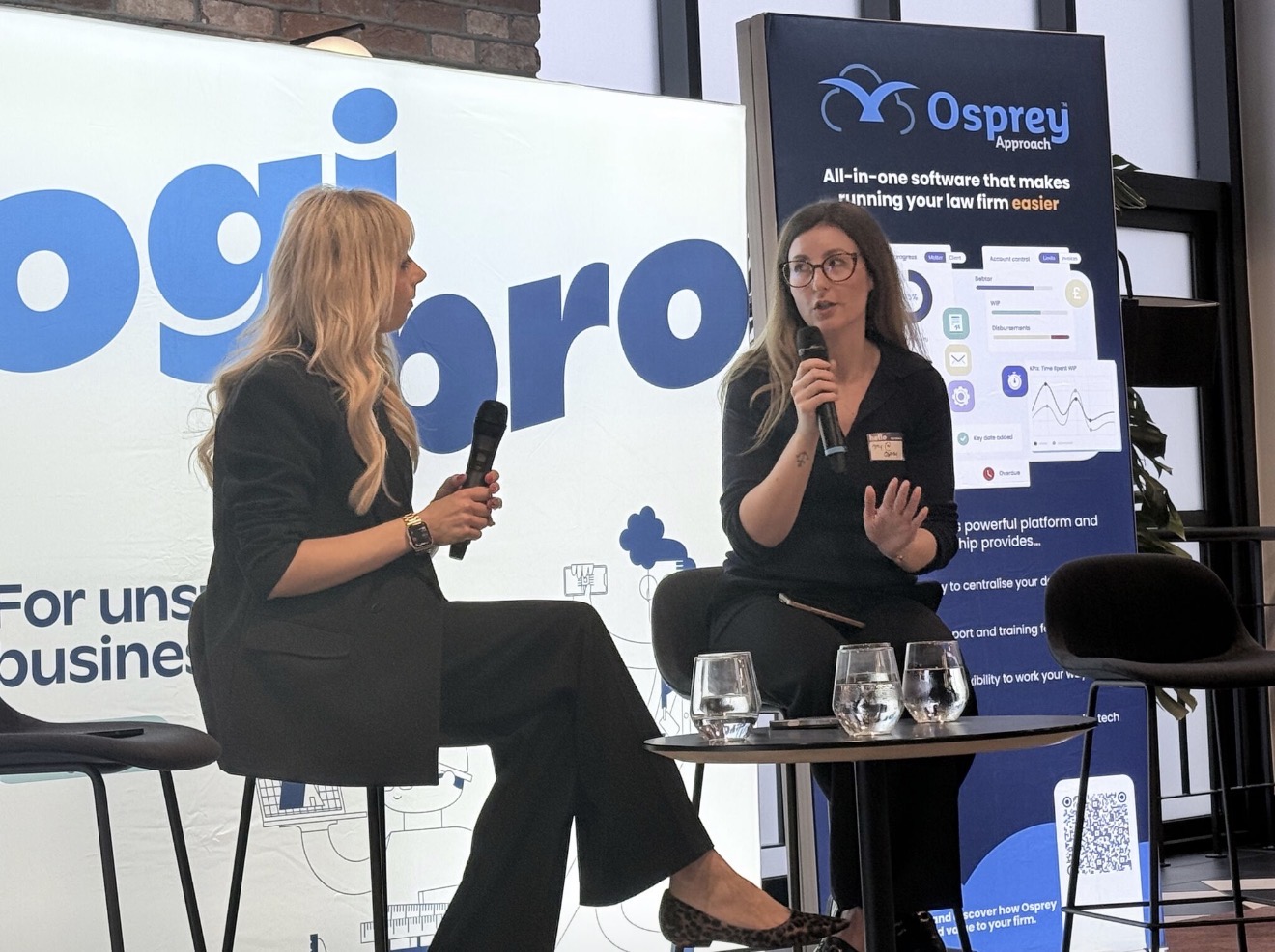
Later in the programme, Amy Bruce, Marketing Director at Osprey Approach and host of the Empowering Law Firm Leaders podcast, shared insight from her conversations with managing partners and transformation leaders across the legal sector.
Drawing on those discussions, Amy highlighted that while interest in AI is accelerating across law firms, many organisations are still grappling with the practical realities of implementation. She said:
“There is a huge amount of curiosity in the sector right now, but many firms are still figuring out what AI actually means for their organisation and how it fits with their strategy.”
A recurring theme Amy sees across the firms and podcast guests she speaks with, is the importance of data readiness:
“If your data is in a mess, you’re never going to get value from AI. Data governance is the foundation for everything that follows.”
Rather than attempting to overhaul systems overnight, Amy encouraged firms to begin experimenting with AI in controlled environments:
“Nobody is ever truly ready but maturity comes from having the right foundations — organised data, governance and security.”
She added that many firms are starting with small pilot groups to explore potential use cases and understand where AI can deliver genuine value, and stressed the importance of AI project allies:
“Find the curious people in your organisation and give them the time to explore. Remove some of the billing pressures on your AI champions and free them up to invest in pilots, sandbox exercises and to promote the benefits to others.
“Those early champions often become the people who help others understand what works and what doesn’t, and they’ll help to understand and even mitigate the cultural blockers within your organisation, if given the time to do so.”
Amy also emphasised that AI adoption should not be viewed purely as a technology project.
Instead, she said, it requires leadership teams to consider how the technology could reshape workflows, pricing and client relationships:
“AI isn’t just a technology decision, it’s a leadership and operational decision about how your firm creates value.”
In particular, Amy suggested the rise of AI tools could place pressure on traditional billing structures.
“If work can be delivered more efficiently, firms will need to think strategically about how they price and market their services.
However, she believes the technology also presents an opportunity for lawyers to focus more on the human elements of legal practice:
“AI can remove a lot of the administrative burden. That gives lawyers more time to focus on the work that really matters to clients.”
Amy’s insights echoed a message heard across the afternoon — that AI adoption is ultimately a leadership challenge as much as a technological one.
For many firms, the first step will be understanding their own data, workflows and strategy before investing in new tools.



Demonstrating AI in practice
The event also included a practical demonstration from James Thorogood, on behalf of Ogi Pro, who showcased the capabilities of Microsoft Copilot.
James demonstrated how AI assistants can summarise documents, analyse data, automate repetitive tasks and support knowledge retrieval across organisations.
“The goal of tools like Copilot is not to replace professionals, he said; “it’s to give them time back so they can focus on the work that really matters.”
James highlighted that AI adoption must be accompanied by strong governance and clear policies:
“Organisations need to think carefully about how these tools are implemented, what data they have access to, and how they are used responsibly.”
The Real Questions Law Firms Are Asking About AI
Prior to the event, Legal News Wales asked attendees what their high priority concerns are around AI. James covered some of the most popular ones off during his talk:
- What does ‘good governance’ of AI look like in a law firm today?
“For most firms, it’s not about inventing something new — it’s about extending the controls you already trust: permissions, information barriers, data classification, audit trails, and accountability.”
- How do we prevent hallucinations and ensure defensible outputs?
“No firm wants AI making things up. The key point is that enterprise AI, when properly configured, isn’t a black box — it’s constrained, grounded in approved data, and reviewed by humans. Just like a junior colleague, it accelerates the work, but the lawyer remains responsible for the final judgement.”
- What does transparency with clients and regulators really mean?
“We’re also seeing growing focus on transparency — not just internally, but with clients, insurers, and regulators. Firms want to be able to say what AI is used for, what it is not used for, where data sits, and how outputs are reviewed. That’s becoming part of trust, not a nice‑to‑have.”
- How can SMEs adopt AI safely without overburdening teams?
“For smaller and mid‑sized firms, the challenge is slightly different. How do you adopt AI safely without creating huge overheads or complexity? The answer tends to be incremental — start with the tools you already pay for, pilot with a small group, put guardrails in place, and scale once confidence is built.”
- How do we preserve human legal judgment while embedding AI into workflows?
“There’s the most important question of all: how do we preserve human legal judgement? AI should never replace professional expertise. Its role is to remove friction — first drafts, summaries, comparisons — so lawyers can spend more time advising, strategising, and exercising judgement.”
“The good news is that none of these questions are theoretical. These concerns are already being addressed in practice — e.g. using Microsoft 365 Copilot, existing controls, and proven legal‑sector approaches.”
CoPilot Masterclass
To follow the event, Ogi Pro and Legal News Wales are hosting a CoPilot Masterclass on 25 March 2026 – a free event in Cardiff for the legal profession. Further details below, and here.
Cybersecurity in the age of AI
The final session focused on cybersecurity and responsible AI adoption, delivered by Jon Stock, Chief Information Risk Officer at PureCyber.
Jon warned that while AI offers significant productivity gains, it also introduces new risks:
“AI doesn’t change the fundamentals of cybersecurity, it reinforces the importance of getting the basics right — knowing where your data is, who has access to it and how it is protected.”
At the same time, Jon noted that generative AI is lowering the barriers for cybercriminals.
“The barrier to entry for attackers is getting lower. AI can help criminals generate phishing campaigns or malicious code far more quickly.”
For law firms handling sensitive client data, robust governance and security controls are therefore essential.
“AI innovation must go hand in hand with strong security and risk management,” Jon said.
Collaboration across the sector
Across the programme, speakers repeatedly returned to the same conclusion: AI is unlikely to replace lawyers, but it will reshape how legal services are delivered and where human expertise adds the greatest value.
Closing the event, Emma reflected on the importance of collaboration across the Welsh legal sector as it navigates technological change:
“The firms that succeed will be those that combine curiosity with governance, experimentation with leadership, and innovation with responsibility.”
“We have a real opportunity in Wales to take advantage of our collaborative nature, to share knowledge, support each other and lead these conversations together.”
Invitation: Ogi Pro x Legal News CoPilot Masterclass
Following the recent LegalTechWales Roadshow AI special Legal News Wales has partnered with Ogi Pro to host a bespoke Copilot masterclass for law firms. Taking place in Cardiff on Wednesday March 2026, the session will feature a live demo, legal-sector use cases, and practical guidance on implementing Copilot to support transformation and business efficiency. Book your free place now.
They’ll share a live demo, discuss use cases for your sector, and outline practical steps to get Copilot working confidently in your business.
Book now
Join Legal News and Ogi for this exclusive event. Click here to book your free place.
Event Resources
- Presentation – Aisling O’Connell, Solicitors Regulation Authority (click here)
- Presentation – James Thorogood, Ogi Pro (click here)
- Empowering Law Firm Leaders Podcast – Osprey Approach (click here)
LegalTech Wales Survey 2026
Coming soon: To launch in April 2026, the latest LegalTech Wales survey from Legal News Wales and powered by Osprey Approach, aims to understand attitudes to LegalTech and AI investment, readiness, support required, concerns and opportunities for the whole legal sector in Wales.
Click here to receive a link to our next LegalTech Wales Survey 2026 in April.
The LegalTech Wales Survey 2026 data will be shared in the autumn, along with another Roadshow event and data will be collected anonymously.
